
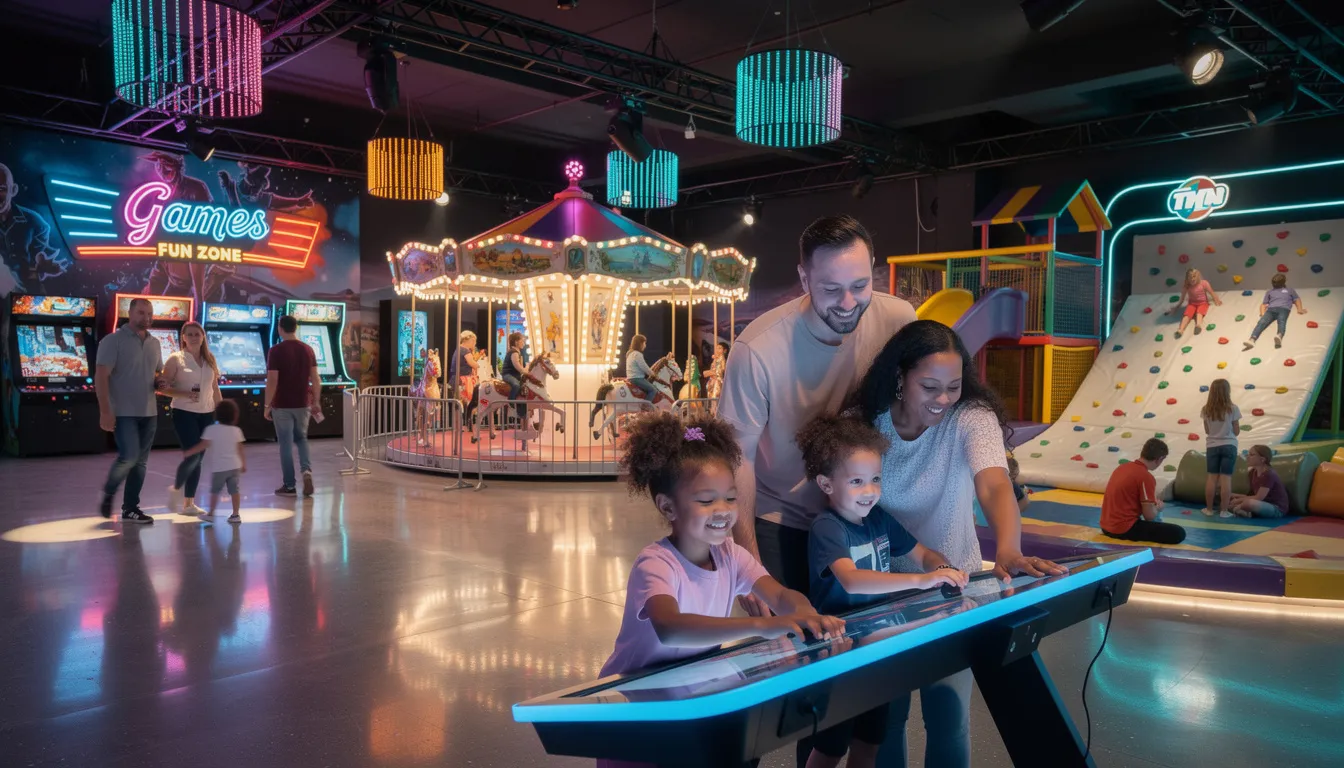
The family entertainment center industry has evolved dramatically from the modest arcades and outdoor mini-golf courses of the 1980s into today’s expansive, multi-attraction destinations that serve entire communities. What began as simple entertainment venues has transformed into a sophisticated sector combining technology, hospitality, and immersive experiences under one roof.
The global market demonstrates robust expansion, valued at approximately USD 28.2 billion in 2023 with projections showing a compound annual growth rate exceeding 10.5% through 2032. In the United States specifically, the arcade, food, and entertainment complexes segment reaches $6.0 billion in 2026, reflecting strong domestic demand for out-of-home family experiences.
Table of Contents
Introduction to the Family Entertainment Center (FEC) Industry
A family entertainment center—sometimes called a family fun center or location-based entertainment venue—refers to for-profit leisure facilities designed to provide multi-generational entertainment. These venues typically range from 10,000 square feet indoor children’s play centers to expansive outdoor fun centers combining arcade games, rides, virtual reality experiences, food and beverage services, and merchandise sales.
The appeal is straightforward: families seeking immersive, all-in-one outing options can access multiple attractions without traveling between locations. Many parents visit FECs three to five times per year, making repeat visits, memberships, and birthday parties essential revenue drivers for operators.
Key industry definitions and data points:
- Family entertainment centers serve ages from toddlers through seniors, with the up-to-12 age group representing the largest family segment
- North America commands approximately 40% of global market share, driven by rising incomes and family-oriented leisure spending
- The entertainment industry continues shifting toward experiential spending over material goods, particularly among young adults aged 20-35
- Revenue streams typically include tickets and admissions, food and beverage, arcade play, party packages, and merchandise
Overview of the Family Entertainment Center Industry
The family entertainment center business thrives on several economic drivers that show no signs of slowing. Rising demand for out-of-home experiences, the “experience over things” spending trend, and parents seeking active alternatives to screen time all fuel growth.
The industry demonstrated notable expansion after 2015, particularly with the trampoline park boom, and showed resilience post-2020 as families returned eagerly to out-of-home entertainment. Urbanization, higher disposable incomes, and technological integrations continue pushing the market forward.
Industry fundamentals for 2024-2025:
- Primary revenue mix includes attractions and admissions, arcade and redemption games, food and beverage operations, birthday parties and group events, memberships, and corporate events
- Major industry associations including IAAPA provide training, safety standards, trade shows, and benchmarking resources for operators
- Consumer preferences increasingly favor immersive theming and innovative attractions over basic, undifferentiated offerings
- Cashless payment systems and dynamic pricing have become standard operational tools
- Data-driven decision making helps operators optimize operations and maximize per-capita spending
- The market remains fragmented, with major players like Dave & Buster’s and Legoland Discovery Centers holding roughly 8% combined share
- Industry trends point toward multi-faceted venues serving all ages rather than single-demographic targeting
Eight (8) Types of Family Entertainment Centers
Family entertainment centers span a wide spectrum—from single-attraction venues to massive multi-entertainment complexes, from indoor-only facilities to hybrid indoor-outdoor destinations. Successful operators often combine several attraction categories to create unique offerings that drive repeat visits and capture diverse revenue streams.
Modern FECs position themselves as destinations where the whole family can find something engaging, regardless of age or interest. Understanding the distinct types helps aspiring operators identify market gaps and match concepts to local demand.
Multi-Entertainment Spaces
Multi-entertainment spaces represent the flagship FEC model, combining multiple anchor activities within large facilities typically spanning 25,000 to 80,000+ square feet.
- Typical attraction mixes include bowling alleys, laser tag arenas, ropes courses, mini golf, bumper cars, VR zones, full arcades, escape rooms, and dedicated event rooms
- These venues serve broad demographics: families with children on weekends, teens seeking fun with friends, young adults on date nights, and corporate groups booking team-building or holiday parties
- Revenue diversity through attractions, food and beverage, parties, walk-in play, group events, and memberships helps smooth seasonality challenges
- Operational complexity requires careful zoning for different noise levels, extensive staff cross-training, and robust management software to coordinate bookings and capacity
- Many new investors pursue this model because it maximizes market capture across multiple guest segments
- The challenge lies in executing multiple attractions well rather than doing many things poorly
Eatertainment Concepts
Modern FECs are evolving into “eatertainment” venues, combining food, beverage, and retail to increase customer dwell time.
- Common attraction pairings include bowling plus arcade, social darts with games, boutique mini golf with craft cocktails, or hybrid restaurants with small ropes courses or VR zones
- Per-cap spending on food and beverage can reach 30-40% of total revenue, especially during evenings targeting adults
- These venues typically position as family-friendly by day and adult-focused in evenings, with leagues, corporate events, and buyouts driving weeknight business
- Kitchen size, service speed, and beverage options directly impact profitability
- Liquor licensing requirements and staff training for responsible service add operational layers
- The eatertainment model has gained momentum since the mid-2010s as operators recognized the margin potential of integrating quality dining with entertainment
The future of FECs lies in creating “smart,” hybrid venues that cater to diverse age groups, offering a blend of physical, social, and digital experiences.
Mini Golf and Putt-Putt Centers
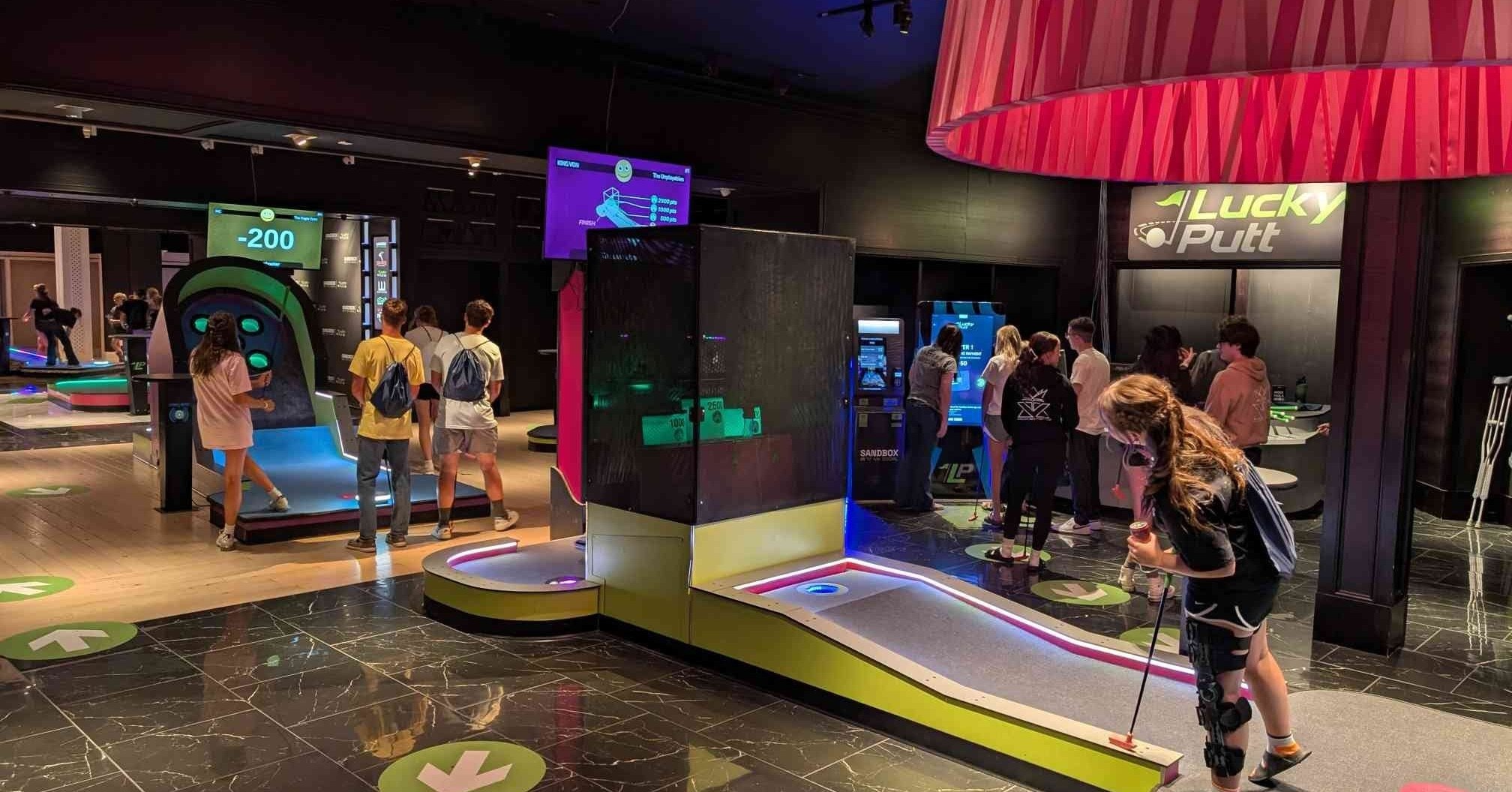
Mini golf and putt-putt centers range from traditional outdoor 18-36 hole courses to modern indoor venues featuring blacklight environments and projection-mapped immersive experiences.
- Appeal spans a wide age range, making these venues suitable for birthday parties, date nights, casual family outings, and corporate events
- Outdoor courses face seasonality challenges in many regions, while indoor attractions offer year-round revenue potential
- Typical price points for a round range from $8-15 for basic courses to $15-25 for premium themed experiences
- Leading edge mini golf includes concepts like PuttShack and Lucky Putt which automatically keeps track of your score and remembers your game history.
- Upsell opportunities include snack bars, small arcades, party rooms, and bundled ticketing with adjacent attractions
- Footprint requirements vary significantly—outdoor courses need substantial land while indoor venues can operate in 8,000-15,000 square feet
- Theming quality increasingly differentiates venues, with elaborate themed environments commanding premium pricing
Arcades and Redemption Centers
Modern arcades operate as cashless, card-based game rooms featuring video games, attractions, and redemption games where guests earn tickets or points for prizes.
- Redemption games drive repeat play and higher per-visit spending, particularly among children and tweens who engage with the prize-earning mechanic
- Key metrics include average game time, swipes per visit, and prize markup strategies that balance guest satisfaction with profitability
- Layout matters significantly—placing high-earning games prominently and ensuring redemption counter visibility influences spending patterns
- Regular game mix refreshes maintain guest interest and drive repeat visits
- Arcades frequently anchor other FEC types (bowling centers, trampoline parks, kids’ play zones) rather than operating standalone
- Integration with management software enables tracking of game performance, identifying underperformers, and optimizing floor layout
Bowling-Anchored Family Entertainment Centers
Traditional bowling alleys have evolved into hybrid bowling entertainment centers featuring upscale food, lounges, and substantial arcades alongside lanes.
- Lane formats include standard layouts and boutique concepts with fewer lanes but higher per-lane revenue through premium experiences
- Revenue balance between league play (consistent weeknight income) and open-play/party bookings (higher per-cap weekends) requires careful scheduling
- Demographic reach spans families on weekends, league bowlers on weeknights, young adults in evenings, and corporate groups year-round
- Capital intensity remains high—lanes, scoring systems, seating, and ongoing maintenance represent significant investment
- Maximizing non-lane revenue per guest through arcade play, food and beverage, and party upgrades drives overall profitability
- Bowling increasingly serves as one anchor among several attractions rather than the sole focus
Kids’ Play Zones and Indoor Playgrounds
Kids’ play zones focus primarily on children under 12, featuring soft play structures, slides, ball pits, obstacle zones, and dedicated toddler areas.
- Common visit occasions include weekday playdates, weekend family outings, birthday parties, and school or childcare field trips
- Design considerations prioritize clear sightlines for parents, separated toddler zones, organized shoe storage, and comfortable seating with Wi-Fi and coffee for caregivers
- Revenue streams typically include time-based play sessions, monthly memberships, birthday party packages, and café sales
- Safety and cleanliness expectations run exceptionally high—daily sanitization protocols and regular equipment inspections directly impact parental trust
- Typical facilities range from 6,000-15,000 square feet with play structures reaching 15-25 feet in height
- Entry pricing commonly falls between $12-25 per child for 2-3 hour sessions, with membership programs offering significant discounts for frequent visitors
Trampoline and Adventure Parks
Trampoline parks emerged as a dominant FEC category around 2010-2012, featuring large indoor spaces with interconnected trampolines and specialized zones for dodgeball, slam-dunk basketball, foam pits, and performance trampolines.
- Many facilities have expanded into “adventure parks” combining trampolines with ninja courses, climbing walls, ropes courses, zip lines, and air tracks
- Strong appeal to older children, teens, and young adults differentiates these venues from traditional kids’ play zones
- Birthday parties and group events drive significant revenue, often accounting for 30-40% of business
- Safety emphasis runs exceptionally high—trained court monitors, comprehensive waiver systems, mandatory grip socks, and adherence to evolving ASTM standards
- Robust software manages digital waivers, capacity control, and timed sessions to handle peak demand without overcrowding
- Operational intensity requires significant staffing during peak hours and continuous safety monitoring throughout operating hours
Laser Tag, VR, and Specialty Attractions
Laser tag arenas and VR attractions represent mid- to high-tech experiences that operate standalone or within multi-attraction FECs.
- Laser tag arena design features maze-like layouts, multi-level platforms, base targets, scoring systems, and dedicated briefing and vesting rooms
- VR offerings range from free-roam arenas to simulator pods and mixed-reality games, drawing teens and adults seeking novel experiences
- Throughput considerations—players per session, session length, equipment turnaround—directly impact revenue potential
- These attractions pair well with arcades and party rooms, creating natural upsell opportunities
- Session pricing typically ranges from $8-15 for laser tag to $15-30 for premium VR experiences
- Party and event packages combining these attractions with food and exclusive access command premium pricing
What to Know Before Starting a Family Entertainment Center
Starting a family entertainment center means entering both the real estate business and the hospitality operations business simultaneously. Success requires careful planning well before construction begins, with realistic expectations about timelines, capital requirements, and competitive positioning.
Aspiring operators should expect 18-36 months from initial concept to grand opening, with cost drivers including build-out, attraction installation, technology systems, and working capital to sustain operations through the ramp-up period.
Research is essential when starting a family entertainment center, including identifying the target audience and analyzing their interests.
Establishing a unique selling point helps differentiate a family entertainment center from competitors.
Critical planning factors:
- Comprehensive market research identifying local demand and competitive gaps
- Attraction mix selection matching community demographics and consumer preferences
- Site selection balancing visibility, access, and facility requirements
- Capital requirements often ranging from $1 million for small scale kids’ play zones to $5-10 million+ for multi-entertainment spaces
- Clear value proposition explaining why families will choose your venue over existing options
- Risk tolerance and contingency planning for the inevitable challenges of new business launch
Market Research and Concept Definition
Thorough market research separates successful FEC launches from costly failures.
- Analyze local demographics within a 15-30 minute drive radius, examining population density, median household income, age distribution, and family household percentages
- Visit every existing entertainment center, fun center, and competing venue within your target radius, cataloging their attractions, pricing, strengths, and weaknesses
- Match concept type to identified gaps—if the market has multiple trampoline parks but lacks quality kids’ play zones, adjust accordingly
- Utilize trade area studies, traffic counts, school district enrollment data, and local economic development reports
- Survey parents and community groups directly through social media, school partnerships, or local parenting organizations
- Census data, county planning documents, and chamber of commerce resources provide valuable market intelligence at no cost
Site Selection and Facility Planning
Location fundamentally impacts FEC success, requiring careful evaluation of multiple factors.
- Prioritize strong visibility from major roads, easy access with minimal traffic friction, ample parking (typically 5-7 spaces per 1,000 square feet), and proximity to residential areas, schools, and retail
- Size requirements vary by concept: 6,000-10,000 square feet for kids’ play zones, 15,000-25,000 square feet for trampoline parks, 25,000-40,000+ square feet for multi-attraction centers
- Ceiling height requirements range from 16-20 feet for basic attractions to 24-30+ feet for trampolines, ropes courses, and climbing walls
- Zoning verification should occur early—entertainment uses face restrictions in many areas
- Efficient layouts ensure clear guest flow from entry through attractions, position party rooms near anchor attractions, and separate loud zones from quieter dining or toddler areas
- Consider build-to-suit construction versus retrofitting existing buildings (former big-box retail spaces offer height and parking but may require significant investment in HVAC and structural modifications)

Business Planning, Funding, and Financial Projections
A robust business plan demonstrates viability to lenders and keeps operators focused on execution.
- Essential plan components include executive summary, market analysis, attraction mix rationale, marketing strategy, operations plan, management team backgrounds, and detailed three-to-five-year financial projections
- Capital budgeting should itemize construction and build-out, attraction equipment, technology systems (POS, cashless, online booking), initial inventory and supplies, pre-opening marketing, working capital, and 10-15% contingency
- Common funding sources include personal equity and investment from friends and family, traditional bank loans, SBA loans for qualifying borrowers, private investors, and occasionally franchising or licensing arrangements
- Financial projections should account for seasonality (summer and holiday peaks, January-February valleys), a 6-12 month ramp-up period after opening, membership revenue growth curves, and debt service coverage requirements
- Realistic margin expectations range from 15-25% EBITDA for well-operated venues after stabilization
- Include sensitivity analysis showing performance under optimistic, expected, and pessimistic scenarios
Operations, Staffing, and Guest Experience
Operational excellence determines whether a well-conceived FEC thrives or struggles.
- Core roles include general manager, attraction leads, party hosts, front desk and cashiers, food service staff, maintenance technicians, and marketing coordinators
- Training programs should address safety protocols, customer service standards, upselling techniques (party add-ons, food bundles, game card upgrades), and emergency procedures
- Standard operating procedures for opening and closing, peak-time staffing, birthday party flows, and event management ensure consistency
- Staffing ratios vary by attraction type—plan for 1 staff member per 15-25 guests in active attractions, with additional coverage for parties and events
- Guest experience mapping from online booking through post-visit follow-up helps identify friction points and opportunities
- Modern FEC management software integrates POS, digital waivers, online ticketing, party booking, and membership management into unified systems
Safety, Risk Management, and Compliance
Safety represents the non-negotiable foundation of FEC operations, directly impacting both guest welfare and business viability.
- Daily inspection checklists for all attractions, equipment, and play areas should be documented and retained
- Clear rules signage, safety briefings before activities, and active supervision create culture expectations
- Insurance requirements typically include general liability ($1-2 million minimum), property coverage, workers’ compensation, and liquor liability for venues serving alcohol
- Compliance obligations span local building and fire codes, health department requirements for food service, and applicable ASTM standards for attractions
- Incident reporting protocols, crisis response plans, and staff communication procedures protect reputation and enable rapid response
- Consistent safety culture becomes a marketing advantage—parents choose venues where they trust their children will be protected
Revenue Streams, Technology, and Data in FECs
Modern family entertainment centers rely on diversified revenue and integrated technology to maximize per-capita spending and drive repeat visits. Single revenue stream dependence creates vulnerability; successful operators build multiple income sources.
Primary revenue categories:
- Admissions and attraction access (often 40-50% of revenue)
- Arcade and game play (15-25%)
- Food and beverage (20-35%, higher in eatertainment concepts)
- Birthday parties and group events (15-30%)
- Memberships and passes (5-15%)
- Retail and merchandise (2-5%)
Technology integrations—cashless systems, online reservations, dynamic pricing, and unified management software—enables operators to track every transaction, understand guest behavior, and make data-driven decisions that improve profitability.
Birthday Parties, Groups, and Memberships
Birthday parties and group events often form 25-50% of revenue for FECs, representing the highest per-cap spending occasions.
- Standard party packages include reserved room time, hosted activities, food and beverage, game cards or attraction access, and often a gift for the birthday child
- Add-on options such as character appearances, premium attractions, extra guests, and enhanced decorations increase average party revenue
- Group pricing for schools, sports teams, scouts, and corporate outings fills weekday capacity and creates community connections
- Online booking tools prevent double-booking disasters and streamline the reservation process for both staff and guests
- Membership and loyalty programs drive visit frequency—monthly passes, play memberships with discounted rates, and points-based rewards systems create ongoing relationships
- Off-peak discounts for parties and groups help balance demand across the week
Cashless Systems and Point-of-Sale Technology
Card-based or RFID systems have become standard for managing arcade play, attraction access, and often food purchases within FECs.
- Benefits include faster transactions, improved spending visibility for guests and operators, reduced cash shrinkage, and ability to run targeted promotions
- Implementation typically requires 2-4 weeks of staff training and guest education during transition
- Integrated gift card programs, mobile-friendly purchase options, and parent-controlled spending limits enhance the guest experience
- POS integration connects front desk sales, arcade systems, food service, and online transactions into unified reporting
- Kitchen display systems connected to POS improve food service speed and accuracy
- Reporting dashboards provide real-time visibility into sales, capacity, and operational metrics
Using Data for Decision-Making
Successful FEC operators analyze data continuously to refine operations and maximize revenue.
- Attraction and game performance metrics (plays per day, revenue per square foot, revenue per machine) identify opportunities to rotate underperformers
- Guest segment tracking distinguishes member behavior from new guest patterns, party hosts from general admission visitors
- Promotion effectiveness analysis reveals which marketing efforts actually drive incremental visits versus discounting existing demand
- Labor-to-sales ratios and average transaction values guide staffing decisions and scheduling
- Visitation frequency tracking identifies guests at risk of lapsing and triggers retention marketing
- Practical applications include adjusting party time slots based on demand patterns, repositioning games based on performance data, and testing pricing changes in specific dayparts
Trends and the Future of the Family Entertainment Center Industry
The family entertainment center industry continues expanding through the 2030s, driven by consumer demand for social, interactive, and technology-enhanced experiences. Post-2020, families demonstrated strong appetite for out-of-home entertainment, and operators who deliver memorable experiences are well-positioned to capture this demand.
Major industry trends:
- Immersive theming and photo-worthy environments designed for social media sharing
- Hybrid indoor-outdoor spaces maximizing seasonal flexibility
- Competitive socializing concepts targeting young adults
- Integration of FECs into retail, dining, and mixed-use developments as traffic-driving anchors
- Technology enhancement through apps, RFID wearables, and augmented reality elements
- Increased focus on inclusive design serving guests of varying abilities
- Data-driven personalization of marketing and guest experience
Consumer behavior shifts are driving explosive growth in the family entertainment space, with parents visiting FECs three to five times a year.
Innovation in Attractions and Experiences
Innovation in attractions keeps offerings fresh and drives repeat visits from guests seeking new experiences.
- Immersive art installations and experience rooms create shareable moments and justify premium pricing
- Projection-mapped mini golf and interactive climbing walls blend physical activity with digital engagement
- Hybrid physical-digital experiences using RFID bands and companion apps extend engagement beyond facility walls
- Seasonal overlays, rotating pop-up attractions, and limited-time events create urgency and marketing opportunities
- Motion-based attractions combining physical activity with gaming elements appeal to fitness-conscious consumers
- Music and atmosphere programming adapted to different dayparts serves families by day and young adults in evenings
Sustainability, Community, and Social Impact
Modern FEC operators increasingly recognize their role as local community anchors beyond pure entertainment.
- Sustainable operations through LED lighting, efficient HVAC systems, recycled materials, and responsible sourcing align with consumer values
- Community engagement through fundraising nights, school partnerships, and team sponsorships builds local loyalty
- Sensory-friendly hours for guests with autism and other sensory sensitivities demonstrate inclusive commitment
- Accessible design ensuring guests with mobility challenges can participate creates welcoming environments for all families
- Positioning as safe, positive “third places” where families and youth can gather supports community wellness
- Partnership opportunities with schools, youth sports organizations, and local businesses create mutual benefit
- Hard work building authentic community relationships pays dividends in loyalty and word-of-mouth marketing
Conclusion: Positioning Your FEC in a Growing Industry
The family entertainment center industry offers substantial opportunity for operators who combine thorough market research with differentiated concepts and operational excellence. With global market projections showing continued double-digit growth and consumer demand for out-of-home experiences remaining strong, well-planned ventures can capture meaningful share in their local communities.
Success in this space comes from understanding your community’s specific needs and delivering experiences that bring families back visit after visit. The operators who thrive will be those who plan meticulously, invest in safety culture, embrace technology for both operations and guest experience, and build genuine connections with their local market. Rather than copying existing competitors, focus on identifying what your community lacks and executing that vision with consistency and care. The path from research to successful operation requires patience, adequate capital, and unwavering commitment to creating memories for the families you serve.
Leave a Reply